Your freelance contract payment terms are the single most important clause in your client agreement. They determine when you get paid, how you get paid, and what happens when payment is late. Yet many freelancers default to whatever the client suggests — or worse, skip payment terms entirely and rely on verbal agreements.
The result is predictable: delayed payments, ambiguous due dates, and awkward conversations about money that should have been settled before work began.
This guide covers every payment term option available to freelancers, explains when to use each one, provides copy-and-paste contract clause templates, and shares negotiation strategies for when clients push back.
What Are Payment Terms and Why Do They Matter?
Payment terms are the conditions under which you expect to be paid for your work. They’re typically defined in your freelance contract and referenced on every invoice. Payment terms specify three things:
- When payment is due: The number of days after invoice receipt (Net 15, Net 30, etc.) or a specific condition (due on receipt, due on delivery).
- How payment should be made: Accepted payment methods (Stripe, PayPal, bank transfer, etc.).
- What happens if payment is late: Late fee percentage, interest rate, and any consequences for non-payment.
Clear payment terms set expectations before work begins. They give both you and the client a shared understanding of the financial obligations, eliminate ambiguity, and provide a contractual basis for follow-up if payment is delayed.
Common Payment Term Options Explained
Due on Receipt
Payment is expected immediately upon receiving the invoice. This is the fastest payment term and works well for small projects, one-time services, and new client relationships where you want to minimize risk.
Best for: Small projects under $1,000, rush jobs, and first-time clients.
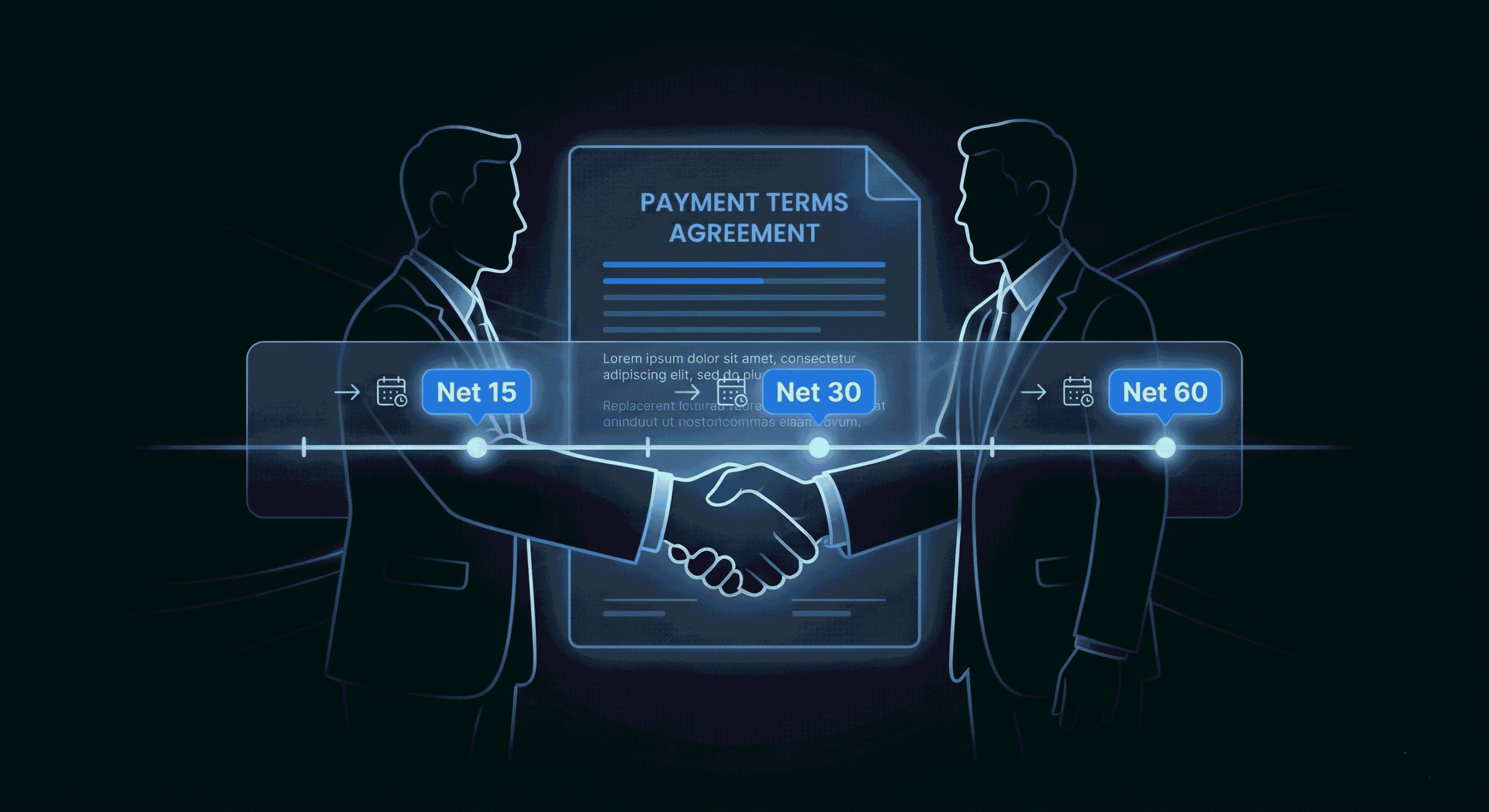
Net 15
Payment is due within 15 calendar days of the invoice date. This is the sweet spot for most freelancers — short enough to create urgency, but long enough for clients to process through their accounts payable cycle.
Best for: Most freelance work. Recommended as your default payment term.
Net 30
Payment is due within 30 calendar days. This is the standard in many corporate environments and is often expected by larger clients. While it’s slower than Net 15, it’s widely accepted and rarely met with pushback.
Best for: Enterprise clients, corporate contracts, and clients who have strict internal payment cycles.
Net 60
Payment is due within 60 calendar days. This is common in some industries (construction, publishing) but is generally too slow for freelancers. Two months without payment creates significant cash flow pressure.
Best for: Only accept Net 60 if the project value justifies it, and always request a substantial deposit (40–50%) upfront to offset the long payment cycle.
Milestone Payments
Payment is divided into multiple installments tied to project milestones. The most common structure for web development and creative projects:
- 30–50% deposit before work begins
- 25–40% at a defined midpoint (e.g., design approval, staging site delivery)
- 20–30% on final delivery and client approval
Best for: Projects over $3,000, multi-phase work, and any engagement where full payment at the end creates too much risk.
Retainer (Prepaid)
The client pays a fixed monthly fee in advance for an agreed scope of work. This is the ideal payment structure for ongoing relationships. Use recurring invoices to automate retainer billing.
Best for: Ongoing maintenance, advisory, support, and any long-term engagement.
Payment Terms Comparison
| Term | Days to Pay | Cash Flow Risk | Best Use Case | Deposit Needed? |
| Due on Receipt | 0 | Very Low | Small/rush projects | No |
| Net 15 | 15 | Low | Most freelance work | Optional |
| Net 30 | 30 | Medium | Corporate clients | Recommended |
| Net 60 | 60 | High | Large enterprise only | Required |
| Milestone | Varies | Low-Medium | Projects >$3K | Built-in |
| Retainer | Prepaid | Very Low | Ongoing relationships | N/A (prepaid) |
Copy-and-Paste Payment Terms Clauses
Here are ready-to-use contract clause templates for the most common payment term scenarios. Customize the bracketed fields for your specific situation.
Standard Net 15 Clause
Payment Terms: All invoices are due within fifteen
(15) calendar days of the invoice date. Payment may
be made via credit card, bank transfer, or other
method specified on the invoice. A late payment fee
of 1.5% per month (18% per annum) will be applied
to any amount outstanding beyond the due date.
Milestone Payment Clause
Payment Schedule:
– [30]% deposit ($[AMOUNT]) due upon contract
execution, before work commences
– [40]% ($[AMOUNT]) due upon completion of
[MILESTONE, e.g., design approval/staging
delivery]
– [30]% ($[AMOUNT]) due upon final delivery and
client approval
Each milestone payment is due within [7] days of
the milestone being met. Work on subsequent phases
will not commence until the prior milestone payment
has been received.
Late Payment Clause
Late Payment: Invoices not paid within the
specified payment period will incur a late fee of
[1.5]% per month on the outstanding balance,
calculated from the original due date. [CONTRACTOR]
reserves the right to suspend all work and
deliverables until overdue invoices are paid in
full. Collection costs, including reasonable
attorney fees, will be the responsibility of
the Client.
Deposit/Retainer Clause
Retainer: Client agrees to pay a monthly retainer
of $[AMOUNT] on the [1st] of each month for
[SCOPE OF SERVICES]. The retainer covers up to
[X] hours of work per month. Hours beyond the
included scope will be billed at $[OVERAGE RATE]
per hour. Either party may cancel the retainer
with [30] days written notice.
How to Negotiate Payment Terms with Clients
Clients will sometimes push for longer payment terms or resist deposits. Here’s how to handle the most common scenarios:
Client: “We pay Net 60. That’s our standard.”
Your response: “I understand that’s your standard corporate cycle. I can work with Net 60, but I’d need a 40% deposit upfront to manage my cash flow on a project of this size. Alternatively, I can offer Net 30 at my standard rate, or Net 15 with a 3% early payment discount.”
Client: “We don’t pay deposits.”
Your response: “A deposit is standard practice for projects of this scope and protects both of us. It secures your spot on my schedule and ensures I can commit the necessary resources from day one. I’m flexible on the percentage — would 25% work for your process?”
Client: “Can we just pay when the project is done?”
Your response: “For a project of this size, milestone payments help manage risk for both sides. I’ll propose a schedule tied to concrete deliverables so you’re only paying for verified progress. This is standard across the industry for projects above $3,000.”
Client: “We don’t agree to late fees.”
Your response: “The late fee clause exists as a mutual incentive for timely payment. I’ve never had to enforce it with a client who pays on time, and I don’t anticipate needing to here. It’s a standard clause in my contracts for all clients.”
How Payment Terms Appear on Your Invoice
Your payment terms should be clearly visible on every invoice you send. Here’s what to include when you create your invoice:
- Due date: The specific date payment is due (not just “Net 15” — show the actual date)
- Payment methods: List all accepted methods with links or details
- Late fee notice: A brief statement (e.g., “Invoices overdue by 7+ days will incur a 1.5% monthly late fee per our agreement”)
- Early payment incentive: If offered, note the discount and qualifying terms (e.g., “3% discount for payment within 7 days”)
For email templates to send when payment terms aren’t met, see our late payment reminder email templates.
Payment Terms Red Flags to Watch For
Some payment term requests from clients are red flags that signal potential payment problems:
- Net 90+: Extremely long payment terms almost always lead to cash flow problems. Decline or require a large deposit.
- “Pay when we can”: This is not a payment term. It’s an open invitation to never pay. Insist on a specific date.
- No written agreement: If a client resists putting payment terms in writing, treat it as a major risk factor.
- History of late payments: Ask for references or check online reviews. If other freelancers report payment issues, proceed with extreme caution.
- Resistance to deposits on large projects: A client who won’t put any money down on a $10,000+ project may not have the funds or the intent to pay.
Frequently Asked Questions
What is the best payment term for freelancers?
Net 15 is the best default payment term for most freelancers. It creates urgency without being unreasonable, and most clients can process within 15 days. For larger projects, combine Net 15 with milestone payments.
Can I change payment terms for an existing client?
Yes. Give the client at least 30 days’ notice and explain the change professionally. A rate increase or scope change is a natural time to adjust payment terms. Put the new terms in an updated contract or addendum.
Should I offer early payment discounts?
For invoices over $5,000, a 2–3% discount for payment within 7 days can significantly accelerate cash flow. For smaller invoices, automated reminders and payment links are more effective and don’t reduce your revenue.
What late fee percentage is standard for freelancers?
1–2% per month (12–24% annually) is the standard range. Check your local regulations for any caps. The goal isn’t to profit from late fees — it’s to incentivize timely payment.
Are verbal payment agreements legally enforceable?
Verbal agreements can be enforceable in some jurisdictions, but they’re extremely difficult to prove. Always put payment terms in a written contract signed by both parties. Email confirmation is better than nothing, but a formal contract is the gold standard.
Set Clear Terms, Get Paid Consistently
Your payment terms are the foundation of your freelance financial health. Set them clearly in your contract, reference them on every invoice, and enforce them consistently. The freelancers who get paid on time aren’t lucky — they’re systematic.
DevInvoice makes it easy to set default payment terms, embed payment links, and automate reminders that keep your billing on track.