Your invoice numbering system might seem like a minor detail, but it’s one of the most important structural decisions you’ll make for your freelance or small business finances. A consistent, well-designed numbering system makes it easy to track invoices, speeds up payment processing, simplifies tax filing, and gives you a professional edge that clients notice.
On the other hand, random, inconsistent, or duplicate invoice numbers create accounting headaches, trigger processing delays at larger companies, and can even cause problems during tax audits. If you’ve ever had a client ask “Which invoice are you referring to?” because your numbering was ambiguous, you’ve felt this pain firsthand.
This guide walks you through the best invoice numbering formats, when to use each one, and how to set up automatic numbering so you never have to think about it again.
Why Your Invoice Numbering System Matters
A well-structured invoice numbering system serves four critical functions:
- Tracking and organization: Every invoice has a unique identifier that lets you quickly find, reference, and sort invoices. When a client emails about “invoice INV-2026-042,” you know exactly what they’re referring to.
- Payment processing: Larger companies use invoice numbers to route payments through their accounts payable system. Missing or duplicate numbers can cause your invoice to be flagged, delayed, or rejected.
- Tax compliance: Many tax jurisdictions require sequential invoice numbering with no gaps. During an audit, a tax authority will check that your invoice numbers run in order — gaps may trigger additional scrutiny.
- Professional credibility: A consistent numbering format signals that you run an organized, professional operation. Clients are more confident paying invoices that look systematic and well-managed.
5 Invoice Number Formats (With Examples)
There’s no single “correct” format. The best choice depends on your volume of invoices, number of clients, and business structure. Here are the five most common formats:
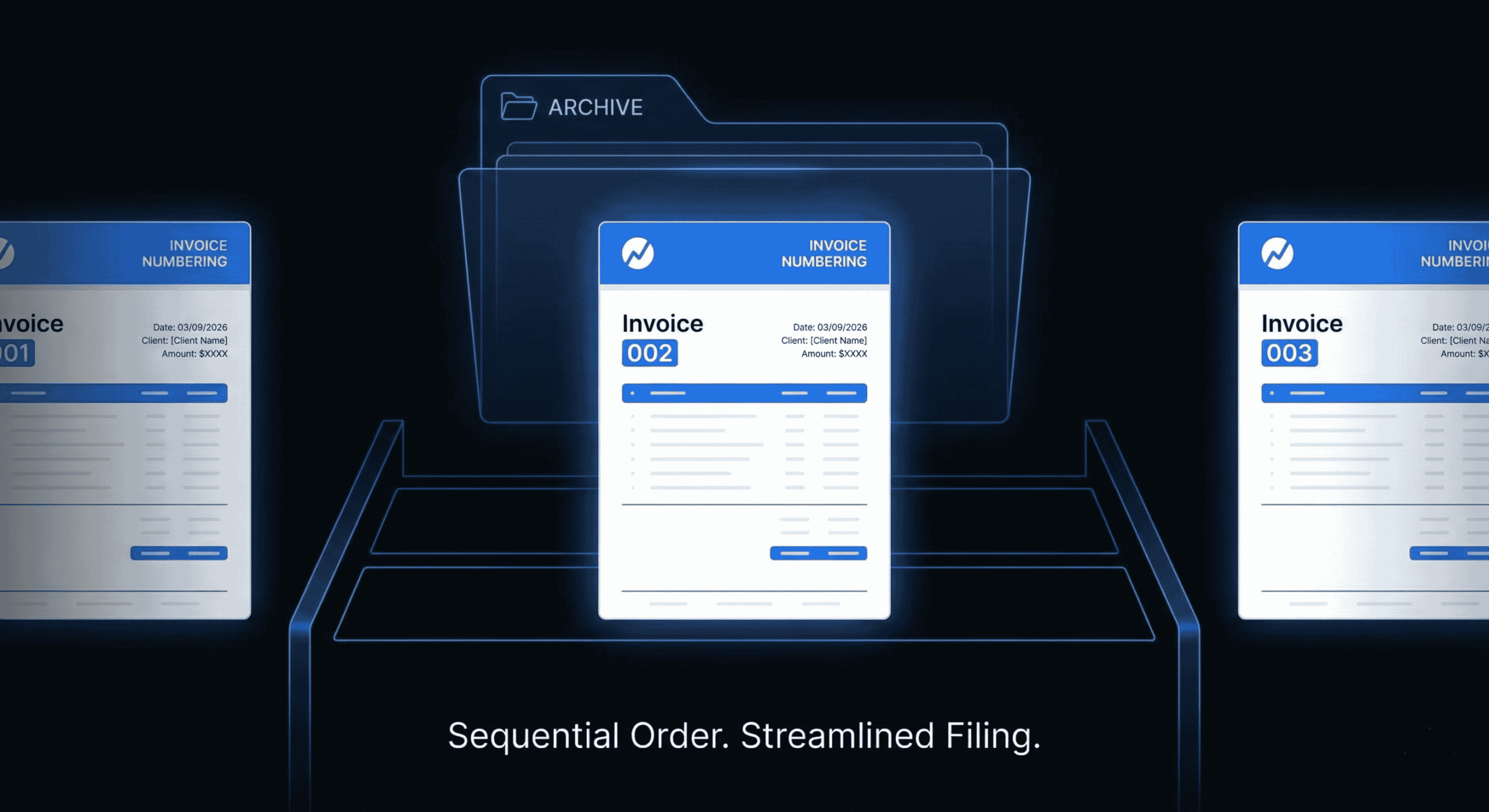
1. Simple Sequential
Format: INV-001, INV-002, INV-003
The simplest approach. Each invoice gets the next number in the sequence. Works well for freelancers with low to moderate invoice volume (under 100 per year). The prefix “INV” makes it immediately identifiable as an invoice.
Pros: Simple, universally understood, easy to implement manually or with any tool.
Cons: No built-in date or client context. Hard to organize by year once volume grows.
2. Year-Based Sequential
Format: INV-2026-001, INV-2026-002 … INV-2027-001
Adds the year to the invoice number, making it easy to sort and filter invoices by fiscal year. The sequence resets at the start of each year. This is the most popular format for freelancers and small businesses.
Pros: Year context at a glance. Easy to track annual totals. Clean reset each January.
Cons: Slightly longer than simple sequential. Requires resetting the counter annually.
3. Client-Based
Format: ACME-001, ACME-002, GLOBEX-001
Each client gets their own numbering sequence using a client code prefix. Useful when you have a small number of long-term clients and want to instantly identify which client an invoice belongs to.
Pros: Instant client identification. Easy to track billing history per client.
Cons: Doesn’t show date context. Can get unwieldy with many clients.
4. Date-Based
Format: 20260309-001, 20260315-002
Uses the invoice date (YYYYMMDD) as the prefix, followed by a daily sequence number. Useful for high-volume invoicing where you might send multiple invoices per day.
Pros: Exact date in the number. Naturally sorts chronologically.
Cons: Long numbers. No client context. Can look overly technical.
5. Project-Based
Format: ACME-WEB-001, ACME-WEB-002, ACME-APP-001
Combines client code, project code, and sequence number. Ideal for developers and agencies managing multiple projects per client. Each project gets its own sequence.
Pros: Full context in the number (client + project + sequence). Great for large, multi-phase projects.
Cons: Longest format. Requires maintaining project codes.
Quick Comparison: Which Format to Choose
| Format | Example | Best For | Date Context | Client Context |
| Simple Sequential | INV-001 | Beginners | No | No |
| Year-Based | INV-2026-001 | Most freelancers | Year | No |
| Client-Based | ACME-001 | Few long-term clients | No | Yes |
| Date-Based | 20260309-001 | High volume | Exact date | No |
| Project-Based | ACME-WEB-001 | Agencies/devs | No | Yes |
Our recommendation for most freelancers: Year-Based Sequential (INV-2026-001). It gives you year context, sorts chronologically, and is universally understood by clients and accountants.
7 Rules for a Bulletproof Invoice Numbering System
- Never skip numbers. Sequential numbering must be continuous — no gaps. If you void an invoice, mark it as voided rather than deleting the number. Tax authorities expect unbroken sequences.
- Never reuse numbers. Every invoice number must be unique, forever. Duplicate numbers cause accounting errors and payment processing failures.
- Start with a prefix. Use “INV”, your initials, or a client code as a prefix. Never start an invoice number with a bare number — it’s harder to search for and can be confused with other reference numbers.
- Use leading zeros. Start with INV-001, not INV-1. Leading zeros ensure consistent formatting and correct alphanumeric sorting (INV-009 sorts before INV-010, but INV-9 sorts after INV-10).
- Keep it short. Invoice numbers should be memorable and easy to reference in conversation. Anything over 15 characters starts to get unwieldy.
- Be consistent. Once you choose a format, use it for every invoice. Don’t switch formats mid-year or mix different styles for different clients (unless using client-based numbering by design).
- Let your tool handle it. Modern invoicing software auto-generates the next sequential number. Don’t manually manage invoice numbers if you can avoid it — manual tracking leads to errors.
Common Invoice Numbering Mistakes to Avoid
- Starting at 1 for a new business: Sending a client “INV-001” advertises that you’re brand new. There’s nothing wrong with starting at INV-100 or INV-1001 to appear more established. This is a cosmetic choice, not a compliance issue.
- Using dates that change format: If you use date-based numbering, stick to one format (YYYYMMDD, never MMDDYYYY or DDMMYYYY). Inconsistent date formats cause sorting nightmares.
- Numbering credit notes the same as invoices: Credit notes should have their own numbering sequence (e.g., CN-2026-001) to distinguish them from regular invoices in your records.
- Deleting voided invoices: Never delete an invoice number. If you need to cancel an invoice, mark it as “voided” and issue a new one with the next number in the sequence.
- Using special characters: Stick to letters, numbers, and hyphens. Avoid slashes (/), dots (.), or other characters that may cause issues in accounting software or payment systems.
How to Set Up Automatic Invoice Numbering
The simplest way to maintain a consistent invoice numbering system is to let your invoicing software handle it. Here’s how it works in DevInvoice:
- Go to Settings > Invoice Preferences
- Set your number format: choose a prefix (e.g., INV), separator (e.g., hyphen), and whether to include the year
- Set the starting number (e.g., 001 or 100)
- Save — every new invoice will automatically get the next sequential number
You can always manually override the number for special cases, but for day-to-day invoicing, automatic numbering eliminates human error entirely.
For the complete process of creating invoices with proper numbering, see our step-by-step guide.
Invoice Numbering and Tax Compliance
Different jurisdictions have different requirements for invoice numbering. Here’s what you need to know:
- United States: No specific federal requirement for invoice numbering format, but sequential numbering is strongly recommended by the IRS for record-keeping purposes.
- European Union (VAT): EU VAT regulations require sequential invoice numbering with no gaps. Each invoice must have a unique, identifiable number that forms part of a continuous series.
- United Kingdom: HMRC requires a unique, sequential identification number on every VAT invoice.
- Canada: The CRA requires a unique invoice number for GST/HST purposes.
- Australia: The ATO requires a unique identifying number on every tax invoice.
For detailed jurisdiction-specific requirements, see our guide on tax invoice requirements for the self-employed.
Frequently Asked Questions
What is the best invoice numbering format for freelancers?
Year-Based Sequential (e.g., INV-2026-001) is the best choice for most freelancers. It provides year context, sorts chronologically, and is universally understood by clients and accountants.
Should invoice numbers always be sequential?
Yes. Sequential numbering is a best practice for organization and is legally required in many tax jurisdictions (especially for VAT/GST). Gaps in your numbering sequence may trigger questions during an audit.
Can I start my invoice numbering at a higher number?
Yes. Starting at INV-100 or INV-1001 instead of INV-001 is perfectly fine. There’s no legal requirement to start at 1. Many freelancers start at a higher number for cosmetic reasons when launching a new business.
What should I do if I accidentally skip an invoice number?
Don’t go back and fill it in. Create a voided invoice for the missing number to maintain the continuous sequence, then continue with the next number. Document the reason for the void in your records.
Does my invoicing software handle numbering automatically?
Yes, most modern invoicing tools (including DevInvoice) auto-generate the next sequential number based on your chosen format. You set the format once and the system handles it from there.
Set Up Your Invoice Numbering System Today
A good invoice numbering system is one you set up once and never worry about again. Choose a format that fits your business, configure it in your invoicing tool, and let automation handle the rest.