As a self-employed freelancer or small business owner, every invoice you send has legal and tax implications. A properly structured tax invoice isn’t just a payment request — it’s a financial document that your clients may need for their tax deductions, that you’ll reference during tax filing, and that a tax authority may scrutinize during an audit.
Getting self-employed tax invoice requirements wrong can result in rejected invoices, delayed payments, compliance penalties, or lost deductions. The rules vary by country and even by state or province, so understanding what applies to your situation is essential.
This guide covers the core requirements for legally valid tax invoices across major jurisdictions, plus practical tips for ensuring every invoice you send is compliant.
What Is a Tax Invoice?
A tax invoice is an invoice that includes the information required by tax authorities for the transaction to be recognized for tax purposes. In many jurisdictions, a tax invoice is specifically required when the seller is registered for sales tax, VAT, or GST and the transaction is taxable.
The key difference between a regular invoice and a tax invoice is the inclusion of tax-specific information: your tax registration number, the tax amount charged, and the tax rate applied. Without these details, the invoice may not satisfy your client’s tax deduction requirements or your own tax reporting obligations.
Universal Requirements (Apply Everywhere)
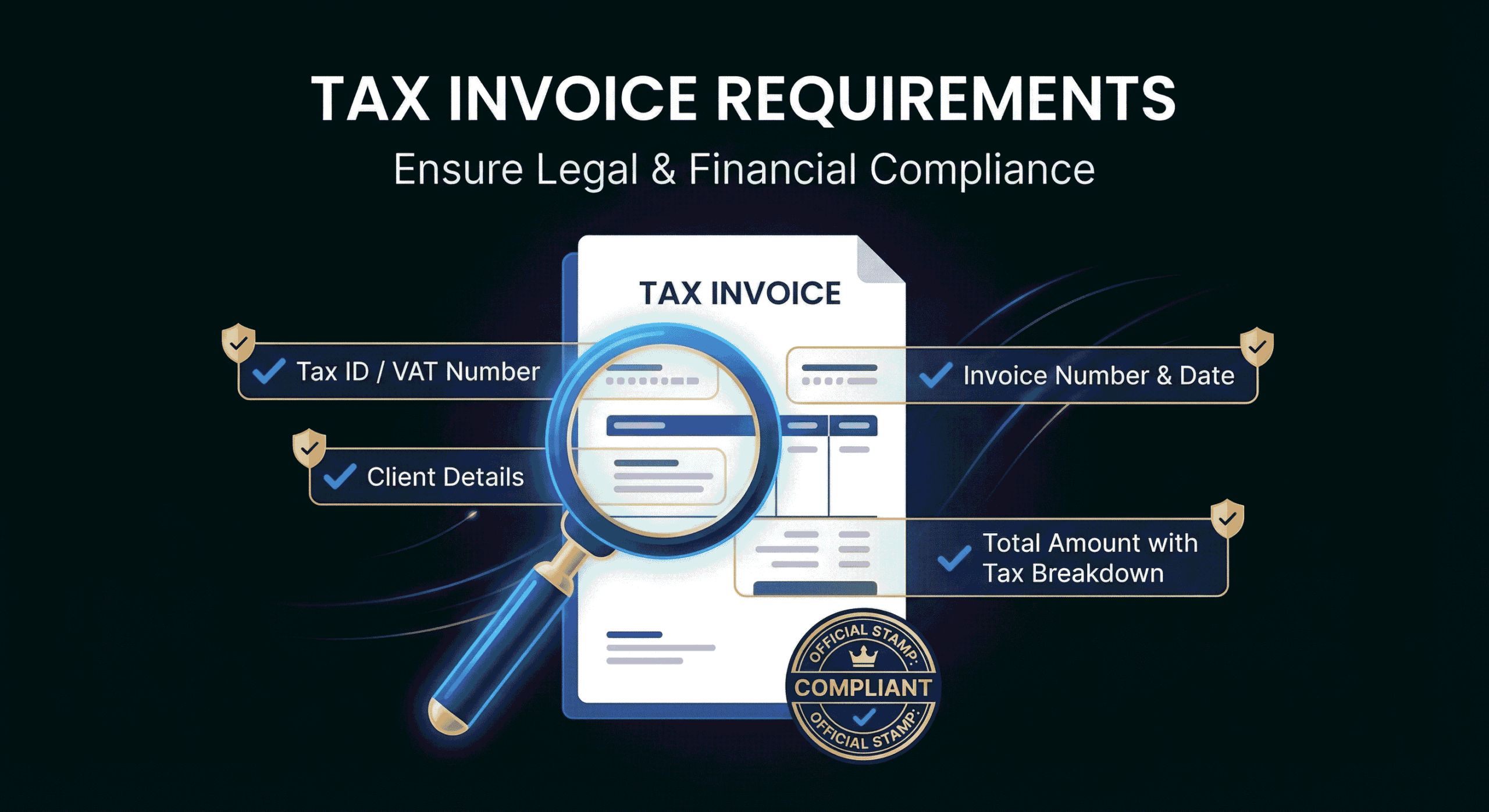
Regardless of your jurisdiction, every tax invoice should include these core elements:
- Your full legal name or business name. The name registered with your tax authority, not a nickname or abbreviated version.
- Your business address. The physical address associated with your tax registration.
- Your tax identification number. SSN/EIN (US), VAT number (EU/UK), GST/HST number (Canada/Australia), or equivalent.
- Client’s name and address. The legal name of the entity you’re billing.
- Unique, sequential invoice number. See our invoice numbering system guide for best practices.
- Invoice date. The date the invoice was issued.
- Description of services or goods. Itemized list with enough detail for the tax authority to understand what was provided.
- Quantity and unit price. For each line item.
- Tax rate and tax amount. The applicable tax rate(s) and the calculated tax for each line item or the total.
- Total amount due (including tax). The final amount the client needs to pay.
- Payment terms. Due date and accepted payment methods.
Country-Specific Tax Invoice Requirements
United States
The US does not have a federal requirement for a specific invoice format. However, the IRS expects self-employed individuals to maintain accurate financial records, including invoices, for income reporting. Key points:
- Tax ID: Include your EIN (Employer Identification Number) or SSN. Clients may request a W-9 form for their records.
- Sales tax: If you’re registered to collect sales tax in your state, include the state tax rate, tax amount, and your state tax registration number on invoices for taxable services.
- 1099 reporting: Clients who pay you $600+ in a year need your tax ID for 1099-NEC reporting. Include it on your invoices to avoid W-9 requests.
- Record retention: The IRS recommends keeping invoices and financial records for at least 3 years (7 years for some situations).
European Union (VAT)
EU VAT regulations have strict requirements for tax invoices. If you’re VAT-registered, your invoice must include:
- Your VAT identification number
- The client’s VAT number (for B2B transactions within the EU)
- Sequential invoice number with no gaps
- Date of supply (when the service was provided)
- The VAT rate applied and the VAT amount
- The total amount excluding VAT, the VAT amount, and the total including VAT
- For reverse-charge transactions: a note stating “Reverse charge applies”
- For intra-EU B2B services: the client’s VAT number must be verified and included
United Kingdom
Post-Brexit, the UK has its own VAT invoicing rules that largely mirror EU requirements but with UK-specific details:
- Your UK VAT registration number
- Your business name and address
- Unique sequential invoice number
- Date of issue and date of supply
- Client’s name and address
- Description of goods/services
- VAT rate, VAT amount, and total (ex-VAT and inc-VAT)
- For simplified invoices (under £250): reduced requirements apply
Canada
- Your GST/HST registration number (if registered)
- The total amount of GST/HST charged or a statement that the price includes GST/HST
- Your legal business name
- Date of invoice
- For invoices over $150: client’s name and payment terms are also required
Australia
- The words “Tax Invoice” must appear on the document
- Your ABN (Australian Business Number)
- Date of issue
- Description of items/services
- GST amount for each item (or a statement that the total price includes GST)
- Total amount including GST
- For invoices over AUD $1,000: buyer’s identity and ABN are also required
Tax Invoice Compliance Checklist
Use this checklist before sending any tax invoice:
- Legal business name or full personal name included
- Business address matches tax registration
- Tax ID / VAT / GST number displayed
- Client’s legal name and address correct
- Unique sequential invoice number assigned
- Invoice date and supply date included
- Line items are clearly described and itemized
- Tax rate(s) and tax amount(s) shown separately
- Total amount includes subtotal, tax, and grand total
- Payment terms and due date specified
- Currency clearly indicated
- Jurisdiction-specific requirements addressed (VAT reverse charge, ABN, etc.)
Common Tax Invoice Mistakes
- Missing tax ID. The most common compliance error. Without your tax registration number, the invoice may not satisfy the client’s deduction requirements.
- Incorrect tax rate. Applying the wrong tax rate (or forgetting to apply tax entirely) creates compliance issues for both you and the client.
- No distinction between pre-tax and post-tax amounts. Always show the subtotal, tax amount, and total separately. Bundling them into one number is non-compliant in most jurisdictions.
- Gaps in invoice numbering. Tax authorities expect continuous numbering. Gaps can trigger audit inquiries.
- Incorrect reverse-charge handling. For EU cross-border B2B transactions, failing to apply or note the reverse charge correctly is a common and costly error.
How DevInvoice Handles Tax Compliance
DevInvoice simplifies tax invoice compliance with built-in features:
- Tax profiles: Set up tax rates for different jurisdictions and apply them automatically based on the client’s location.
- Tax ID display: Your tax registration number is stored in your business profile and appears on every invoice automatically.
- Sequential numbering: Auto-generated, gap-free invoice numbers that satisfy compliance requirements.
- Multi-currency with tax: Apply tax calculations correctly even when invoicing in foreign currencies.
- PDF export: Professional PDF invoices that include all required tax information for record-keeping.
Frequently Asked Questions
Do I need to charge sales tax / VAT as a freelancer?
It depends on your jurisdiction, annual revenue, and the type of services you provide. In the US, most states do not require sales tax on services (but some do). In the EU and UK, you must register for VAT once you exceed the registration threshold. Consult a local tax professional for your specific situation.
What happens if my invoice doesn’t meet tax requirements?
The client may reject the invoice or be unable to claim it as a tax deduction. You may face compliance penalties during a tax audit. In most cases, you can issue a corrected invoice to resolve the issue.
Do I need to include my client’s tax ID on the invoice?
For B2B transactions in the EU (VAT), including the client’s VAT number is required. In Australia, invoices over AUD $1,000 must include the buyer’s ABN. In the US and Canada, it’s not typically required but can be helpful for the client’s records.
How long should I keep copies of my invoices?
The IRS recommends 3–7 years. HMRC requires 6 years. The ATO requires 5 years. When in doubt, keep records for at least 7 years. Digital records (PDFs) are accepted in virtually all jurisdictions.
Stay Compliant, Get Paid
Tax invoice compliance isn’t glamorous, but it’s essential. A properly structured tax invoice protects you during audits, helps your clients claim deductions, and prevents payment delays caused by rejected invoices.