Consulting is a fundamentally different service to bill for than tangible deliverables. When you build a website, the client can see and use the output. When you provide strategic advice, facilitate decision-making, or lead organizational change, the value is real but the deliverable is less tangible. This makes your invoice for consultants critically important — it needs to clearly communicate the value delivered, justify the investment, and make payment effortless.
This guide provides a free consulting invoice template, covers the billing models specific to consulting work, and shares the invoicing practices that keep client relationships healthy and payments on time.
Why Consultants Need a Different Invoice Approach
Consulting invoices face unique challenges that product and project invoices don’t:
- Value perception: A 2-hour strategy session that saves a client $100,000 in bad decisions is worth far more than $200. Your invoice needs to frame the value, not just the time.
- Mixed billing models: Consultants often combine hourly advisory time, fixed-price deliverables (reports, audits), retainer access, and expense reimbursement on a single invoice.
- Executive audience: Your invoice may be reviewed by C-level executives, board members, or finance teams who expect a high level of professionalism and clarity.
- Long-term relationships: Consulting engagements often span months or years. Consistent, clear invoicing maintains trust over the long term.
- Expense pass-through: Travel, software, research materials, and other project expenses are common in consulting and need to be billed separately.
Consulting Billing Models Explained
Hourly Billing
The most straightforward model. You track time spent and bill at your hourly rate. Best for advisory sessions, ongoing support, and situations where the scope is fluid.
Invoice structure: Date → Description of work → Hours → Rate → Amount. Group entries by week or by workstream.
Project-Based / Fixed Fee
A single fixed price for a defined deliverable: a market analysis report, a strategic plan, an organizational audit, a process optimization engagement. The client pays for the outcome, not the hours.
Invoice structure: Deliverable name → Description → Fixed amount. Use milestone payments for large engagements.
Monthly Retainer
A fixed monthly fee for ongoing advisory access. The client gets a defined scope of availability (e.g., “Up to 15 hours of advisory per month including 2 strategy sessions”). Use recurring invoices to automate this billing.
Invoice structure: Monthly retainer fee + overage hours (if any) + expenses.
Value-Based Pricing
Pricing tied to the expected outcome or ROI of the engagement. Example: a consultant who helps a company reduce costs by $500K might charge $50K–$100K for the engagement. The invoice reflects the agreed project fee, typically paid in milestones.
Day Rate
Common for on-site consulting, workshops, and intensive sessions. A single daily rate covers all work performed that day, regardless of specific hours. Typical day rates range from $1,500–$5,000+ depending on specialization and seniority.
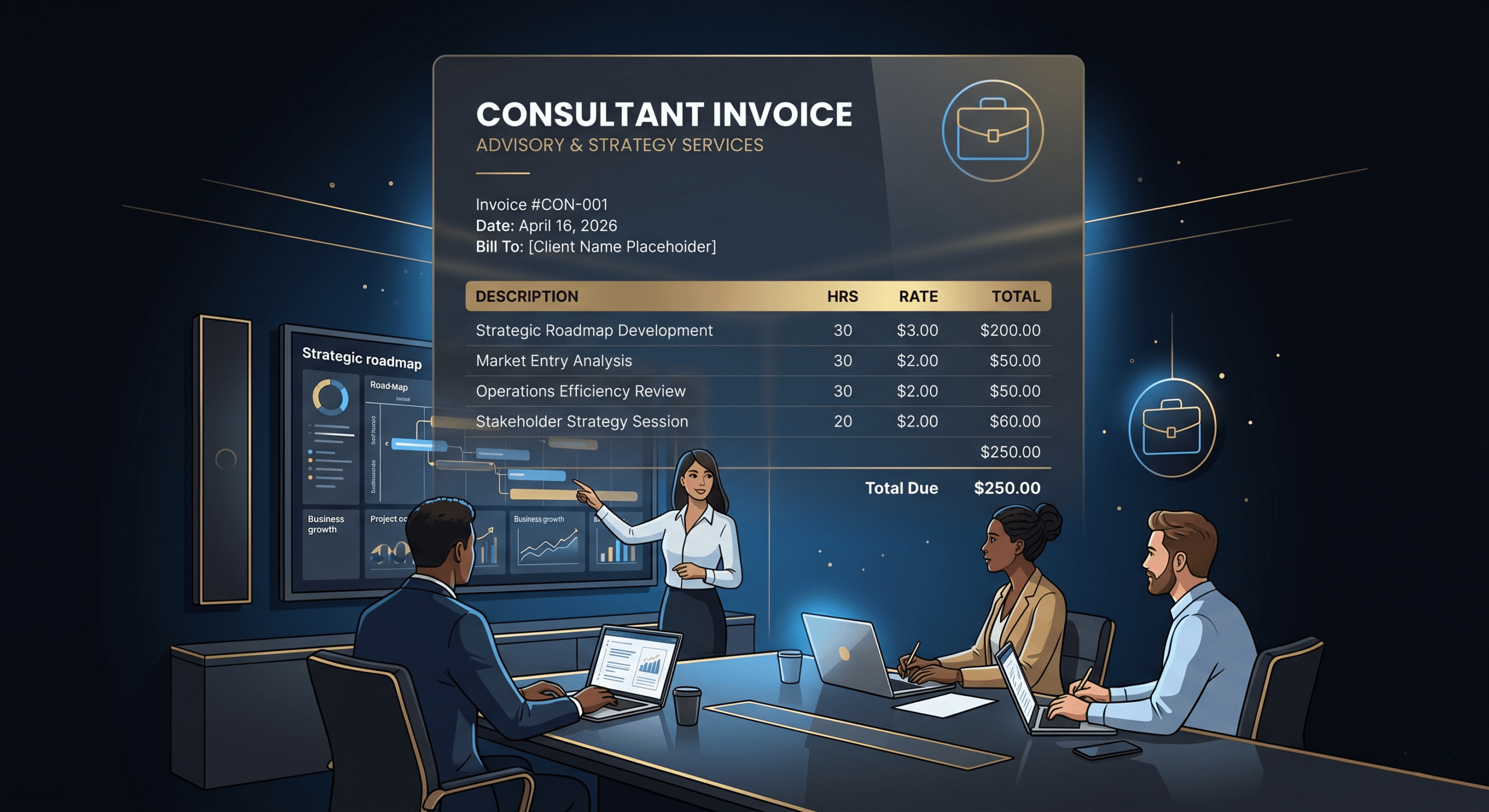
Sample Consulting Invoice Structure
| Description | Qty | Unit | Rate | Amount |
| Monthly Advisory Retainer (March 2026) | 1 | month | $4,500 | $4,500 |
| Strategy Session — Q2 Planning | 3 | hours | $250 | $750 |
| Market Analysis Report — APAC Expansion | 1 | deliverable | $3,200 | $3,200 |
| Overage Hours (beyond retainer scope) | 2.5 | hours | $275 | $687.50 |
| EXPENSES | ||||
| Travel — Client on-site visit (flights+hotel) | 1 | trip | — | $1,245 |
| Software License — Market Research Tool | 1 | month | — | $199 |
Note: Expenses are listed separately with supporting documentation (receipts) attached. Overage hours use a premium rate ($275 vs. the effective retainer rate) as specified in the contract.
Handling Expenses on Consulting Invoices
Expense pass-through is standard in consulting. Best practices:
- Define reimbursable expenses in your contract. Travel, accommodation, meals (typically capped at a per diem), software, and research materials are common categories.
- Require pre-approval for expenses over a threshold. e.g., “Expenses over $500 require client approval before incurrence.”
- Attach receipts to the invoice. Include scanned receipts or a PDF expense report as supporting documentation.
- List expenses as separate line items. Don’t bundle expenses into your service fees. Transparency builds trust.
- Apply markup only if contractually agreed. Some consultants add a 10–15% handling fee on expenses. Others pass through at cost. Be clear about your approach.
8 Invoicing Best Practices for Consultants
- Frame line items in value language. “Q2 Revenue Growth Strategy Development” is better than “Strategy work — 6 hours.” The client should see impact, not just activity.
- Include a brief executive summary. For large invoices ($5K+), add a 2–3 sentence summary of the work performed and outcomes achieved during the billing period.
- Bill retainers in advance. Invoice on the 1st for the upcoming month’s retainer. This ensures you’re paid before work begins, not after.
- Track overage hours carefully. If the client exceeds the retainer scope, document and communicate before invoicing. Surprise overages damage trust.
- Use Net 15 payment terms. Consulting clients can typically process within 15 days. Net 30 just delays your cash flow unnecessarily.
- Embed Stripe payment links. Even executive clients appreciate one-click payment. See our Stripe setup guide.
- Send a pre-invoice notification. For retainer clients, send a brief email 3–5 days before the invoice: “Your March invoice will be sent on April 1st for $X.” No surprises.
- Maintain a consistent format. Your invoice should look the same every month. Consistency signals professionalism and makes it easy for the client’s accounting team to process.
Frequently Asked Questions
Should consultants charge hourly or use retainers?
Retainers are generally better for ongoing consulting relationships — they provide predictable income for you and predictable costs for the client. Use hourly billing for one-off advisory sessions or when the scope is too variable to price as a retainer.
How do I bill for a strategy session?
Bill the session at your hourly or half-day rate, including preparation time. A 2-hour strategy session typically involves 1–2 hours of preparation and 30 minutes of follow-up notes — bill for all of it.
Should I charge for travel time?
Yes, if the client is requiring on-site presence. Bill travel time at 50% of your standard rate, or include a flat travel day fee. Specify this in your contract before the engagement begins.
What if a client questions a line item on my consulting invoice?
Address it directly and professionally. Reference the scope document or retainer agreement, provide supporting detail (time logs, meeting notes, deliverable descriptions), and resolve the question promptly. Clear invoices prevent most questions; good documentation resolves the rest.
How do I transition from hourly to value-based pricing?
Start by tracking the business impact of your work (revenue generated, costs saved, time reduced). When you can quantify the ROI, propose a project fee based on a percentage of the expected value (typically 10–20% of projected impact). Value-based pricing works best for high-impact, clearly measurable engagements.
Invoice Like a Professional Consultant
Your invoice is the final touchpoint of every billing cycle. Make it reflect the same professionalism and clarity you bring to your consulting work. Clear line items, transparent expenses, and effortless payment options ensure you get paid on time — every time.