Copywriting and content writing billing has its own unique dynamics. You might charge per word for blog posts, per project for website copy, per hour for strategy sessions, and monthly retainers for ongoing content production — all for different clients. A generic invoice doesn’t capture these nuances, which leads to client confusion and slower payments.
An effective invoice template for copywriters clearly communicates the billing model, specifies revision terms, and documents content licensing — so the client knows exactly what they’re paying for and what rights they’re receiving.
Copywriter Billing Models
Per-Word Pricing
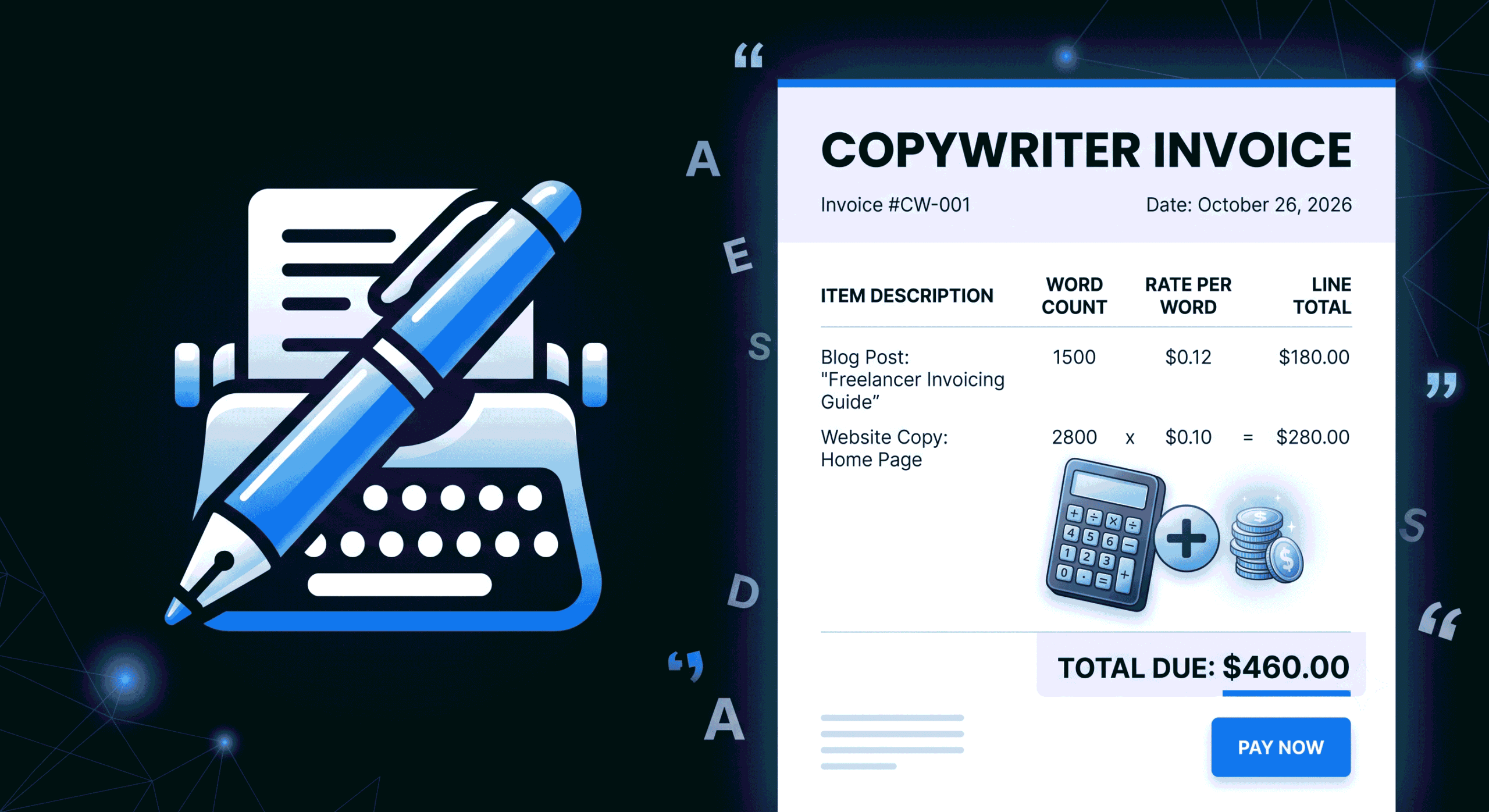
The most transparent model for blog posts, articles, and long-form content. Rates range from $0.10–$0.50/word for standard content to $0.50–$2.00/word for specialized or technical writing. Invoice format: “Blog Post: ‘[Title]’ — 1,500 words @ $0.25/word = $375.”
Per-Project Pricing
Fixed fees for defined deliverables: website copy ($2,000–$10,000), email sequence ($500–$3,000), landing page ($500–$2,000). The client pays for the outcome, not the word count. Invoice as a single line item per deliverable.
Hourly Billing
Used for strategy work, content audits, editorial consultations, and research-heavy projects. Track hours and bill at your hourly rate ($50–$200+/hr depending on specialization).
Monthly Retainer
Fixed monthly fee for an agreed output: “8 blog posts + 20 social media captions + 4 email newsletters per month.” This is the ideal model for ongoing client relationships. Automate with recurring invoices.
Sample Copywriter Invoice
| Description | Qty | Unit | Rate | Amount |
| Blog Post: “10 Email Marketing Mistakes” | 1,800 | words | $0.25 | $450 |
| Blog Post: “Guide to Landing Page Copy” | 2,200 | words | $0.25 | $550 |
| Website Copy: About Page Rewrite | 1 | page | $600 | $600 |
| Email Sequence: Onboarding (5 emails) | 1 | sequence | $1,200 | $1,200 |
| Research & Interviews (Subject Experts) | 3 | hours | $85 | $255 |
| Revision Round 1 (included) | 1 | round | — | $0 |
| [EXTRA] Revision Round 2 | 1.5 | hours | $100 | $150 |
Handling Revisions on Copywriting Invoices
Content revisions are the most common source of scope creep for writers:
- Include 1 revision round in the price. Show it as a $0 line item for transparency.
- Define what a “revision” means. Changes to existing copy within the approved brief. A complete rewrite or new direction is a new deliverable, not a revision.
- Bill additional revisions at your hourly rate. $85–$120/hr for revision work beyond the included round.
- Get brief sign-off before writing. An approved content brief prevents “this isn’t what I wanted” situations that lead to full rewrites.
For broader revision management, see our scope creep prevention guide.
Content Licensing for Writers
- Work-for-hire (most common): Client owns all rights to the content. This is standard for website copy, blog posts, and marketing content. Included in the project fee.
- First rights: Client gets exclusive first publication rights. After a defined period (90 days, 1 year), you can republish. Common for journalism and editorial.
- Licensed use: Client can use the content for specific purposes and channels. You retain copyright. Less common but used for premium content like whitepapers and ebooks.
For most copywriting work, work-for-hire is the default and doesn’t need a separate license fee. If you’re retaining rights, specify the license type on the invoice.
7 Invoicing Best Practices for Writers
- Specify the deliverable title on each line item. “Blog Post: ‘[Exact Title]’” is better than “Blog post writing.” The client knows exactly which piece they’re paying for.
- Show word count for per-word billing. The word count IS the quantity. Make it visible: “1,800 words @ $0.25/word.”
- Invoice on content delivery. Send the invoice the same day you deliver the content. Don’t wait for the client to review and approve first (that’s what the revision round covers).
- Separate research from writing. If a project requires significant research or expert interviews, bill them as separate line items.
- Use Net 15 payment terms. Writers often deal with late payments. Shorter terms create urgency.
- Collect 50% deposit for large projects. Website copy, ebook writing, and email sequences over $2,000 should require a deposit before work begins.
- Embed a Stripe payment link. One-click payment from the invoice dramatically reduces payment friction for writing clients.
Frequently Asked Questions
Should copywriters charge per word or per project?
Per-word works best for standardized content (blog posts, articles) where word count correlates with effort. Per-project works best for strategic or creative work (website copy, email sequences, brand voice) where the value isn’t tied to length. Many copywriters use both models for different types of work.
How do I handle rush writing requests on my invoice?
Charge a 25–50% rush premium for turnarounds under 48 hours. Label it clearly: “Rush Delivery Premium (24-hour turnaround): +$175.” Include rush fee terms in your contract so clients know upfront.
What if a client asks for unlimited revisions?
Never agree to unlimited revisions. One included round is standard for copywriting. Additional rounds are billed hourly. If the client needs extensive revisions, the issue is usually the brief — suggest a paid brief development session before the next project.