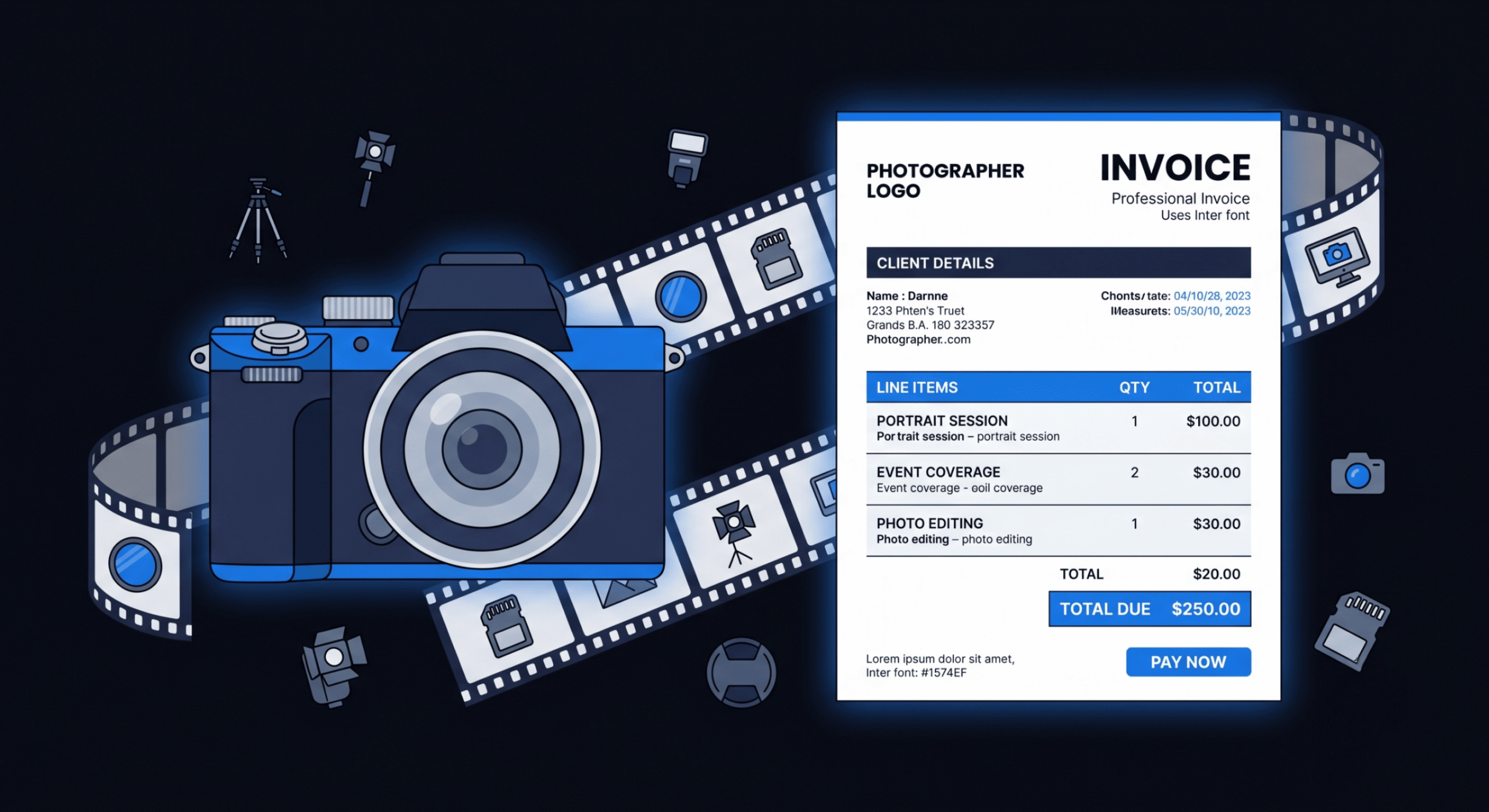
Photography invoicing has unique demands that generic templates can’t handle. Between shoot fees, post-processing hours, travel expenses, equipment rental, and photo licensing rights, a photographer’s invoice needs to clearly communicate the full value of what’s being delivered — not just “photos taken.”
An effective invoice template for photographers breaks down every billable element so clients understand exactly what they’re paying for, reducing questions and speeding up payment. Whether you shoot weddings, corporate events, product photography, or portraits, this guide gives you a free template and the billing practices that keep your photography business profitable.
Why Photographers Need a Specialized Invoice
Photography billing differs from typical service invoicing in several important ways:
- Session vs. deliverable pricing: Some photographers charge per session (2-hour portrait session), others per deliverable (25 edited images), and many use a hybrid. Your invoice needs to accommodate all three.
- Post-production time: Editing, retouching, and color grading often take 2–3x longer than the actual shoot. Clients need to see this as a distinct billable item.
- Travel and location expenses: On-location shoots involve travel time, mileage, accommodation, and sometimes location fees. These pass-through costs need clear documentation.
- Equipment rental: Specialty lighting, drone equipment, or studio rental fees should appear as separate line items.
- Photo licensing and usage rights: The commercial value of photographs extends beyond creation. Different usage rights (personal, commercial, exclusive) have different price points.
- Deposit and milestone structure: Wedding and event photographers typically collect a booking deposit (25–50%), with the balance due before file delivery.
Sample Photography Invoice Structure
| Description | Qty | Unit | Rate | Amount |
| Wedding Photography — Full Day Coverage | 8 | hours | $250 | $2,000 |
| Second Photographer (Assistant) | 8 | hours | $125 | $1,000 |
| Post-Production: Culling & Selection | 3 | hours | $85 | $255 |
| Post-Production: Color Grading & Retouching | 6 | hours | $95 | $570 |
| Album Design & Layout | 1 | album | $350 | $350 |
| Travel — Round-trip to Venue (85 miles) | 170 | miles | $0.67 | $113.90 |
| Equipment: Drone Coverage | 1 | session | $200 | $200 |
| LICENSING | ||||
| Personal Use License (Web + Print) | 1 | license | Included | $0 |
| Commercial Use License (Venue Marketing) | 1 | license | $500 | $500 |
| Less: Booking Deposit Received (3/1/2026) | -$1,500 |
Note: The personal use license is included in the session fee (shown as $0 for transparency). The commercial license for venue marketing is a separate, priced line item. The booking deposit is deducted from the total.
How to Invoice for Different Types of Photography
Wedding & Event Photography
The highest-value photography niche and the most complex to invoice. Typical structure: booking deposit (25–50%) collected when the date is reserved, balance due 2 weeks before the event or upon gallery delivery. Include coverage hours, second photographer fees, post-production time, album design, and travel separately.
Use milestone payments and collect the deposit as early as possible. For wedding photography, the deposit secures the date and covers your opportunity cost if the event is canceled. Reference your cancellation policy in the invoice notes. For payment structuring, see our freelance payment terms guide.
Portrait & Headshot Sessions
Typically billed as a session fee plus per-image charges for edited photos. Example: “1-hour portrait session: $300. Includes 5 edited images. Additional edited images: $45 each.” This model is clean, easy for clients to understand, and incentivizes clients to purchase additional images.
Product Photography
Billed per product, per image, or per day. eCommerce product photography often uses per-image pricing (“$35/image, minimum 20 images”) while lifestyle product shoots are billed as day rates plus post-production. Include setup time, styling, and props as separate line items if significant.
Corporate & Commercial Photography
Typically billed as a day rate or half-day rate plus licensing fees. Corporate headshots, office environments, event coverage, and marketing materials each have different rate structures. Always include a separate commercial usage license — the images will be used in marketing, which has commercial value beyond the shoot itself.
Real Estate Photography
Usually billed per property with a tiered pricing model: basic listing photos, premium editing with virtual staging, drone/aerial coverage, and video walkthrough. Quick turnaround (24–48 hours) is expected, so factor processing speed into your pricing.
Photo Licensing on Your Invoice
Licensing is where many photographers leave money on the table. Similar to how graphic designers handle usage rights (see our graphic designer invoice guide), photographers should include licensing terms on every invoice:
Personal Use License
Client can use images for personal, non-commercial purposes: social media posts, personal websites, personal printing. This is typically included in the session fee.
Standard Commercial License
Client can use images for business purposes: website, social media marketing, brochures, advertising. Priced as a separate line item, typically 30–50% of the session fee.
Exclusive / Full Buyout License
Client receives exclusive rights to the images. You cannot resell, relicense, or use the images in your portfolio (unless negotiated). Premium pricing: typically 2–3x the standard commercial license fee.
Extended Commercial License
Covers usage beyond the original scope: nationwide advertising campaigns, merchandise, billboards, international distribution. Priced case-by-case based on the scope and duration of use.
Always include licensing terms on your invoice. Even a brief statement like “Personal use license included. Commercial licensing available upon request.” establishes that you retain copyright and additional usage requires agreement.
8 Invoicing Best Practices for Photographers
- Invoice immediately on gallery delivery. Send the invoice the same day you deliver the photo gallery or proofs. Work is fresh, client is excited about the images — this is the best moment for payment.
- Collect deposits before the shoot date. For weddings and events, collect 25–50% at booking. For commercial shoots, collect 50% before the shoot day. This protects against cancellations and no-shows.
- Separate shoot time from editing time. Clients often undervalue post-production. Showing “Post-Production: 6 hours” on the invoice communicates the real effort behind the final images.
- Include a delivery manifest. List exactly what’s being delivered: number of edited images, file formats (JPEG, TIFF, RAW), resolution, and delivery method (online gallery, USB, cloud link).
- Use package pricing for simplicity. For portrait and headshot work, packages (“Silver: 1hr + 10 images = $450”) are easier for clients to understand than hourly + per-image breakdowns.
- Don’t deliver final files before full payment. Share watermarked previews or a locked online gallery for review. Release the high-resolution, unwatermarked files only after payment is confirmed.
- Use recurring invoices for ongoing clients. Real estate agents, restaurants, and brands with regular photo needs benefit from automated monthly invoicing.
- Embed a Stripe payment link. Clients pay in one click directly from the invoice. No bank transfer details, no check mailing, no delays.
Common Photography Invoice Mistakes
- Bundling everything into one line item: “Photography services: $3,500” tells the client nothing. Break it down by shoot time, editing, travel, and licensing.
- Forgetting to deduct the deposit: If you collected a booking deposit, show it as a credit on the final invoice. “Less: Deposit received on [date]: -$1,000.”
- Not mentioning licensing: If there’s no licensing statement, the client may assume they have unlimited rights. Always specify what’s included and what requires additional licensing.
- Sending invoices weeks after delivery: The longer you wait, the lower the urgency. Invoice on delivery day.
- No invoice number: Every invoice needs a unique number for your records, the client’s accounting, and tax compliance.
Frequently Asked Questions
Should I charge per hour or per image?
It depends on the type of work. Portrait and headshot photography works well with session + per-image pricing. Commercial and event photography is better as hourly or day rates plus post-production. Product photography is commonly priced per-image. The key is choosing a model that’s easy for your specific clients to understand.
How much should I charge for photo licensing?
Personal use licensing is typically included in the session fee. Standard commercial licensing ranges from 30–50% of the session/project fee. Exclusive/buyout licensing is 2–3x the standard commercial rate. Always base pricing on the scope and duration of usage.
When should I send my photography invoice?
Send the final invoice on the same day you deliver the photo gallery or proofs. For deposits, send the deposit invoice immediately after the client confirms the booking. For milestone payments, invoice at each agreed checkpoint.
Should I charge for travel to a shoot location?
Yes, for any location beyond your standard service area. Charge the IRS standard mileage rate ($0.67/mile in 2026) plus any accommodation, parking, or toll expenses. List travel as a separate line item on the invoice.
What if a client wants photos from a shoot I did a year ago?
If the original agreement didn’t include extended access or archival storage, you can charge a retrieval and re-delivery fee. If they want additional editing on archived images, bill at your current hourly editing rate. Specify your image retention policy in your contract.
Create Your Photography Invoice in Minutes
Stop formatting invoices from scratch after every shoot. DevInvoice lets you create professional, branded photography invoices with line items for sessions, editing, travel, and licensing — complete with Stripe payment links so clients pay in one click.