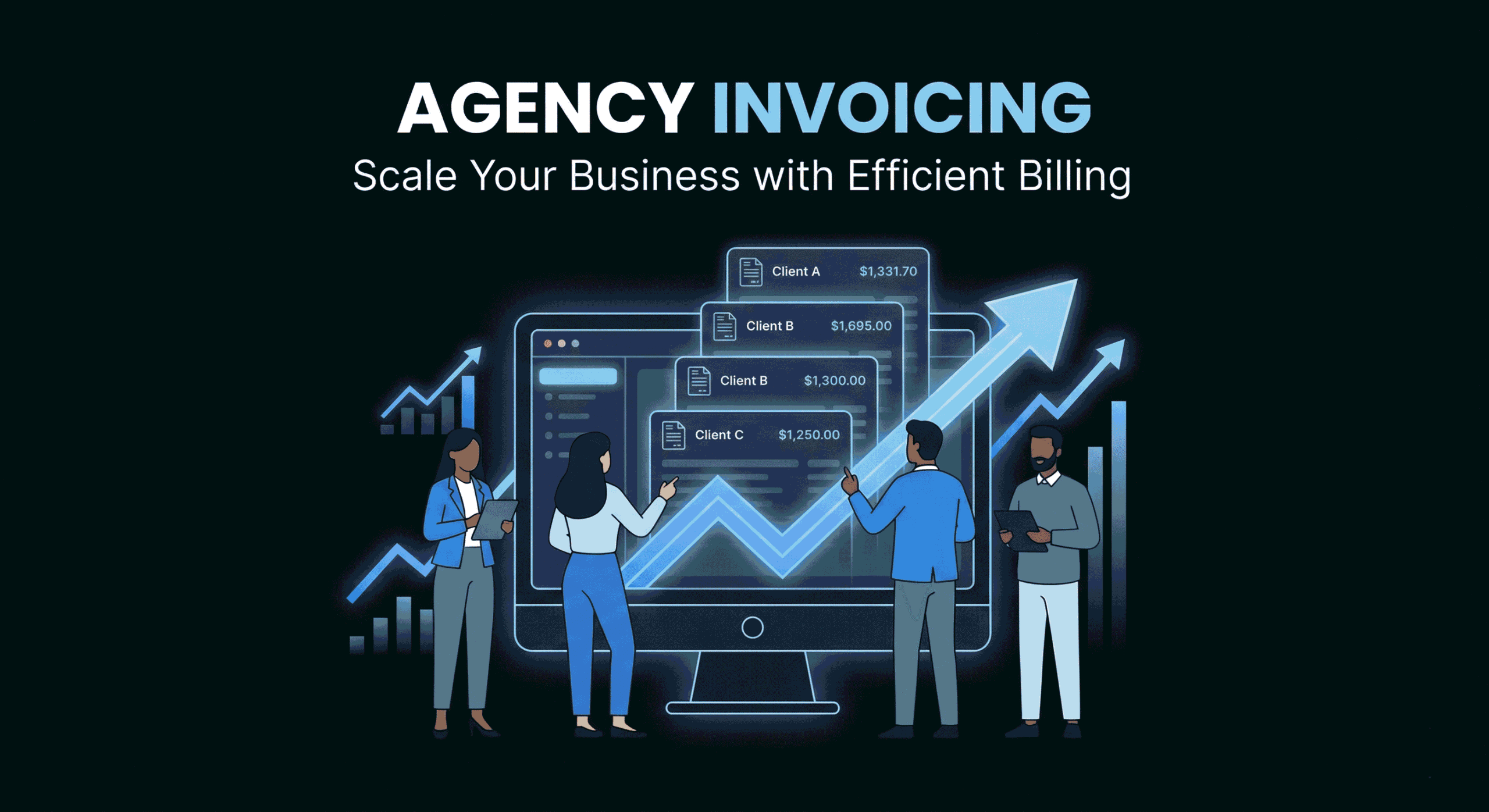
The transition from solo freelancer to small agency is one of the most exciting — and financially complex — phases of a service business. When it was just you, invoicing was straightforward: track your hours, create an invoice, send it. But the moment you bring on subcontractors, hire employees, or manage multiple simultaneous client projects, your invoicing for small agencies needs to evolve dramatically.
The billing workflows that worked for a solo freelancer break down at the agency level. You’re now managing multiple team members’ time across multiple clients, handling different rate structures, tracking project profitability, and ensuring every billable hour is captured and invoiced accurately.
This guide covers the invoicing challenges specific to small agencies (2–15 people), the systems and tools that solve them, and the best practices that keep your billing clean as you scale.
When Solo Invoicing Stops Working
Here are the signals that your invoicing process needs to level up:
- You’re invoicing for other people’s time. When team members track hours and you have to consolidate their time logs into client invoices manually, errors creep in and hours get missed.
- Different clients have different rate structures. Client A pays $120/hr for senior dev time, Client B pays a $5,000 monthly retainer, Client C is on a fixed-price project. One invoicing template no longer fits.
- You’re losing track of what’s been billed. With multiple projects running simultaneously, it’s hard to remember which work has been invoiced and which hasn’t.
- Project profitability is unclear. You know you’re busy, but you can’t tell which clients are profitable and which are costing you money.
- Invoice preparation takes hours. If creating monthly invoices takes more than 30 minutes per client, your process doesn’t scale.
Key Invoicing Challenges for Small Agencies
1. Multi-Person Time Tracking
When a team of 3–5 people works on a single client project, you need a system that captures everyone’s time accurately and rolls it up into a single invoice. This requires either a shared time tracking tool or an integration between your PM tool (like Asana) and your invoicing platform. See our Asana invoicing integration guide for one approach.
2. Multiple Billing Models
Agencies typically juggle three or more billing models simultaneously:
- Hourly: For ongoing support, maintenance, and ad-hoc work
- Fixed-price: For defined-scope projects with clear deliverables
- Retainer: For ongoing monthly engagements with a set scope of hours
- Value-based: For strategic work where pricing is tied to outcomes, not hours
Your invoicing tool needs to handle all of these without requiring separate templates or workflows for each. Recurring invoices handle retainer billing automatically.
3. Subcontractor vs. Employee Billing
When you use subcontractors, their cost is different from their bill rate. Your invoicing and accounting needs to track both: the rate you bill the client and the rate you pay the subcontractor. The difference is your margin, and it needs to be visible at the project level.
4. Expense Pass-Through
Agencies often pay for client-specific expenses (hosting, software licenses, stock photos, domain registrations) that need to be passed through to the client on the invoice. These should be separate line items with clear descriptions and, ideally, attached receipts.
5. Project Profitability Tracking
Knowing whether a project was profitable requires comparing the revenue invoiced against the cost of labor and expenses. At the solo level, this is simple math. At the agency level, with multiple people at different rates working on the same project, you need systematic tracking.
How to Structure Agency Invoices
Agency invoices need more structure than solo freelancer invoices. Here’s the recommended layout:
Header
- Agency name, logo, and contact information
- Client’s company name and billing contact
- Invoice number, date, and due date
- Project name or engagement reference
- Billing period (e.g., “March 1–31, 2026”)
Line Items — Grouped by Category
Group line items into clear sections. For a typical agency invoice:
- Team labor: Each team member’s hours as a separate line item with their role, hours, and rate. Example: “Senior Developer (Sarah M.) — Frontend Development — 18 hrs @ $120/hr”
- Project management: PM time tracked separately so the client sees the management overhead
- Pass-through expenses: Hosting, licenses, tools, etc. with descriptions and amounts
- Change orders: Clearly separated and labeled as out-of-scope work
Totals
- Subtotal by category
- Applicable taxes
- Less: Any deposits or prior milestone payments
- Total due
Footer
Payment instructions, payment terms, late fee policy, and a thank-you note.
Agency Invoicing Best Practices
- Standardize your billing cadence. Invoice all clients on the same day (e.g., the 1st of each month). Consistent timing makes cash flow predictable and reduces admin overhead.
- Use role-based rates, not person-based. Bill “Senior Developer” at $120/hr regardless of which senior dev worked on it. This simplifies rate management and avoids awkward conversations when team members change.
- Separate billable from non-billable clearly. Internal meetings, admin, and learning time are non-billable. Track them for internal analysis but keep them off client invoices.
- Review invoices with your team. Before sending, have the project lead review the invoice to verify accuracy. A 5-minute review catches errors that would otherwise delay payment.
- Attach a time summary report. For hourly billing, attach a detailed time log as a supporting document. Clients appreciate the transparency and it preempts questions.
- Track utilization rates. Monitor what percentage of your team’s total hours are billable vs. non-billable. Healthy agencies target 60–75% utilization.
- Automate retainer billing. For retainer clients, set up recurring invoices that generate automatically each month. Zero manual effort for predictable revenue.
- Use multi-currency invoicing for international clients. As an agency, you’re more likely to work with overseas clients. Invoice in their currency to reduce friction.
Choosing the Right Invoicing Tool for Your Agency
Not every invoicing tool scales from solo to agency. Here’s what to look for:
- Multi-user access: Team members need to log time and view project data without accessing billing or financial details.
- Project-level reporting: Revenue, costs, and profitability per project and per client.
- PM tool integration: Direct connection to Asana, Trello, or your project management tool of choice.
- Multiple billing models: Support for hourly, fixed, retainer, and milestone billing in one tool.
- Recurring invoices: Automatic monthly billing for retainer clients.
- Client portal: A place where clients can view their invoices, payment history, and outstanding balances.
DevInvoice’s Pro plan supports multi-project invoicing, Asana integration, Stripe payments, recurring billing, and multi-currency support — all the features a growing agency needs at $4.99/month.
Frequently Asked Questions
When should a freelancer switch to agency-level invoicing?
When you start managing subcontractors, hire your first employee, or consistently manage 3+ active client projects simultaneously. If invoice preparation takes more than 30 minutes per client, it’s time to upgrade your process.
Should I bill clients for project management time?
Yes. Project management is a billable service that adds value. List it as a separate line item so the client understands the PM overhead. Typically, PM accounts for 10–20% of total project hours.
How do I handle subcontractor costs on client invoices?
You have two options: (1) Bill the client at your standard role rate without disclosing the subcontractor relationship, or (2) Pass through the subcontractor’s cost with a markup. Option 1 is more common for agencies and keeps pricing clean.
What’s a healthy profit margin for a small agency?
Net profit margins of 15–25% are healthy for small service agencies. If you’re below 10%, review your utilization rates, rate structures, and scope management processes.
How do I track project profitability?
Compare total revenue invoiced per project against total labor cost (hours × internal cost rate) plus expenses. Your invoicing tool should provide project-level revenue reports, and your time tracking should capture cost data.
Scale Your Billing With Confidence
Growing from solo to agency is exciting, but your billing systems need to grow with you. The right invoicing tool, standardized processes, and clear team workflows ensure every billable hour is captured and every client invoice is accurate.