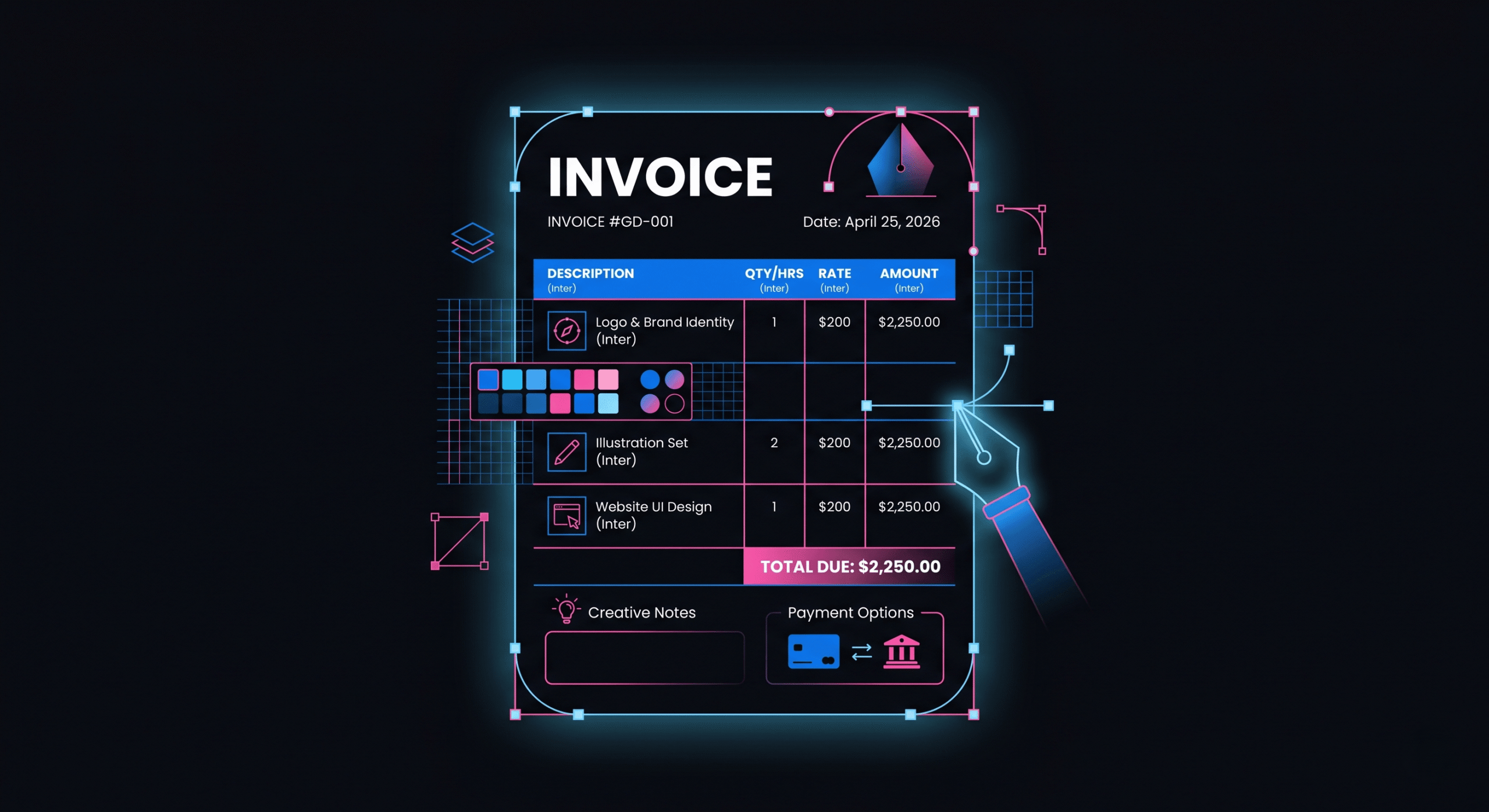
Graphic design projects come with billing nuances that generic invoice templates don’t handle: revision rounds that exceeded the scope, usage rights and licensing fees, multiple deliverable formats, rush turnaround premiums, and the ever-present “can you make the logo bigger?” revision that turns a 2-hour project into a 6-hour one.
A proper invoice for graphic designers accounts for all of these scenarios with clear line items, professional formatting, and a structure that clients understand at a glance. This guide provides a free template, explains how to structure invoices for different types of design work, and covers the billing practices that protect your creative business.
Why Designers Need a Specialized Invoice Template
Design work is different from most service billing in several important ways:
- Revision intensity: Design projects involve iterative feedback cycles. Without defined revision limits, clients can request unlimited changes that destroy your effective hourly rate.
- Usage rights and licensing: The value of a design often extends beyond the creation itself. Logo design, brand identity, and illustration work may require different licensing terms for different usage scenarios (print, digital, merchandise).
- Multiple deliverable formats: A logo project doesn’t produce one file — it produces AI, EPS, SVG, PNG, and PDF versions in various sizes and color spaces. Your invoice should reflect this deliverable scope.
- Concept-based pricing: Clients often request multiple design concepts. Each concept represents significant creative work, and your invoice should differentiate between concept development and production/refinement.
- Rush premiums: Design requests frequently come with tight deadlines. Rush work should be invoiced at a premium rate.
Anatomy of a Graphic Designer Invoice
Building on the standard invoice structure from our how to create an invoice guide, here’s how to customize it for design work:
Header
- Your design studio name/personal name, logo, and contact info
- Client’s company name and billing contact
- Invoice number (use a consistent numbering system)
- Invoice date, due date, and project reference name
Line Items — By Project Phase
Structure your line items to follow the natural phases of a design project:
| Description | Qty | Unit | Rate | Amount |
| Discovery & Creative Brief | 3 | hours | $85 | $255 |
| Concept Development (3 concepts) | 1 | project | $1,800 | $1,800 |
| Selected Concept Refinement | 4 | hours | $85 | $340 |
| Revision Round 1 (included) | 1 | round | — | $0 |
| Revision Round 2 (included) | 1 | round | — | $0 |
| [EXTRA] Revision Round 3 | 2 | hours | $100 | $200 |
| Final File Preparation & Delivery | 2 | hours | $85 | $170 |
| Usage License — Full Commercial Rights | 1 | license | $500 | $500 |
Notice: Included revisions are shown as $0 line items for transparency. The extra revision round is clearly labeled and billed at a premium rate.
Usage Rights Section
For any design work that involves intellectual property (logos, brand identity, illustrations, custom graphics), include a clear usage rights statement:
- Work-for-hire / full buyout: Client owns all rights to the final design. Highest pricing tier.
- Full commercial license: Client can use the design for all commercial purposes. Designer retains copyright for portfolio use.
- Limited license: Client can use the design for specific purposes (e.g., digital only, single campaign). Additional usage requires separate licensing.
Specify the license type on the invoice so the client knows exactly what rights they’re purchasing. This prevents future disputes about usage.
How to Invoice for Different Types of Design Work
Logo Design
Logo projects typically involve concept development (3–5 initial concepts), client selection, refinement rounds, and final file delivery in multiple formats. Bill as a fixed-price project with included revision rounds and a usage license.
Brand Identity Packages
Includes logo, color palette, typography, brand guidelines document, and application mockups. Bill as a phased project: discovery, concept development, refinement, deliverables, and brand guidelines document — each as a separate line item.
Marketing Collateral
Social media graphics, banner ads, flyers, brochures, email templates. These are typically billed per piece or per hour, depending on complexity and volume. For ongoing work, consider a monthly retainer with a defined number of deliverables.
UI/UX Design
Wireframes, mockups, and prototypes for websites or applications. Bill by project phase (wireframes, visual design, prototype) or by screen/page. Include revision limits per phase.
Illustration
Custom illustrations for editorial, advertising, or product use. Bill per illustration with a base fee plus usage licensing. Rush fees and complexity modifiers are common (a simple icon vs. a detailed scene).
Handling Revisions on Your Invoice
Revisions are the most common source of billing disputes for designers. Here’s how to handle them cleanly:
- Define “revision” in your contract. A revision is a change to an existing design within the approved direction. A new concept or a completely different direction is NOT a revision — it’s additional concept development.
- Include 2 revision rounds in the project price. This is the industry standard. Show them as $0 line items on the invoice for transparency.
- Bill additional revisions at a premium rate. $100–$120/hr for extra revisions vs. your standard $85/hr signals that additional rounds have a cost.
- Get sign-off at each stage. Before moving from concepts to refinement, get written approval. This prevents the client from circling back to earlier stages without a change order.
For broader strategies on managing scope additions, see our guide on scope creep in freelancing.
10 Invoicing Best Practices for Graphic Designers
- Brand your invoice. Your invoice IS a design deliverable. Make it look as professional as your portfolio.
- Itemize concept development separately. Clients should see the creative thinking as a distinct billable phase, not bundled into “design.”
- Show included revisions as $0 line items. Transparency about what’s included prevents “but I thought revisions were free” conversations.
- Specify deliverable formats. List the file formats you’re delivering (AI, EPS, PNG, PDF, etc.) so the client knows what they’re getting.
- Always include usage rights on the invoice. Even if it’s in the contract, restate the license type on the invoice for clarity.
- Charge rush fees for tight deadlines. 25–50% premium for turnarounds under 48 hours is standard and justified.
- Use milestone payments for large projects. 50% deposit + 50% on delivery, or 40/30/30 for multi-phase projects.
- Invoice immediately on file delivery. Don’t wait. Send the invoice the same day you deliver final files.
- Attach a file delivery manifest. List every file delivered (filename, format, size) as supporting documentation.
- Use recurring invoices for retainer clients. Monthly social media packages, ongoing brand support — automate the billing.
Frequently Asked Questions
Should I charge separately for usage rights?
Yes, for significant creative work like logos, brand identity, and custom illustrations. Usage rights represent the commercial value of the design beyond the creation time. Smaller deliverables (social media graphics, banner ads) typically include standard commercial rights in the project fee.
How many revision rounds should I include?
Two rounds is the industry standard for graphic design work. Specify in your contract that each round includes one consolidated set of feedback (not multiple back-and-forth exchanges).
What’s a fair rush fee for design work?
25–50% premium over your standard rate for turnarounds under 48 hours. For same-day delivery, 75–100% premium is justifiable. Include rush fee terms in your contract so clients know upfront.
Should I release files before full payment is received?
No. Deliver watermarked previews or low-resolution versions for client review. Release final, production-quality files only after full payment is received and confirmed.
How do I handle a client who wants unlimited revisions?
Explain that unlimited revisions aren’t sustainable for either party — they lead to project bloat and delayed delivery. Offer a generous but defined number of rounds (3 instead of 2) and bill additional rounds at your revision rate.
Download Your Free Designer Invoice Template
Stop spending time on invoice formatting. DevInvoice provides professional invoice templates with built-in branding, line item structure for design phases, and Stripe payment links — so you can send beautiful invoices that match your design quality.