If you’re a freelancer or small business owner, you’ve probably used the terms invoice, estimate, and quote interchangeably at some point. Many clients do too. But these three documents serve fundamentally different purposes in your billing workflow, and using the wrong one at the wrong time can create confusion, set incorrect price expectations, or leave you without the legal backing to collect payment.
Understanding the distinction between an invoice vs estimate vs quote isn’t just academic — it directly affects how clients perceive your pricing, how binding your agreements are, and how smoothly your projects move from proposal to payment.
This guide breaks down each document, explains when to use it, shows you the key differences, and walks through the typical workflow from estimate to invoice.
What Is an Estimate?
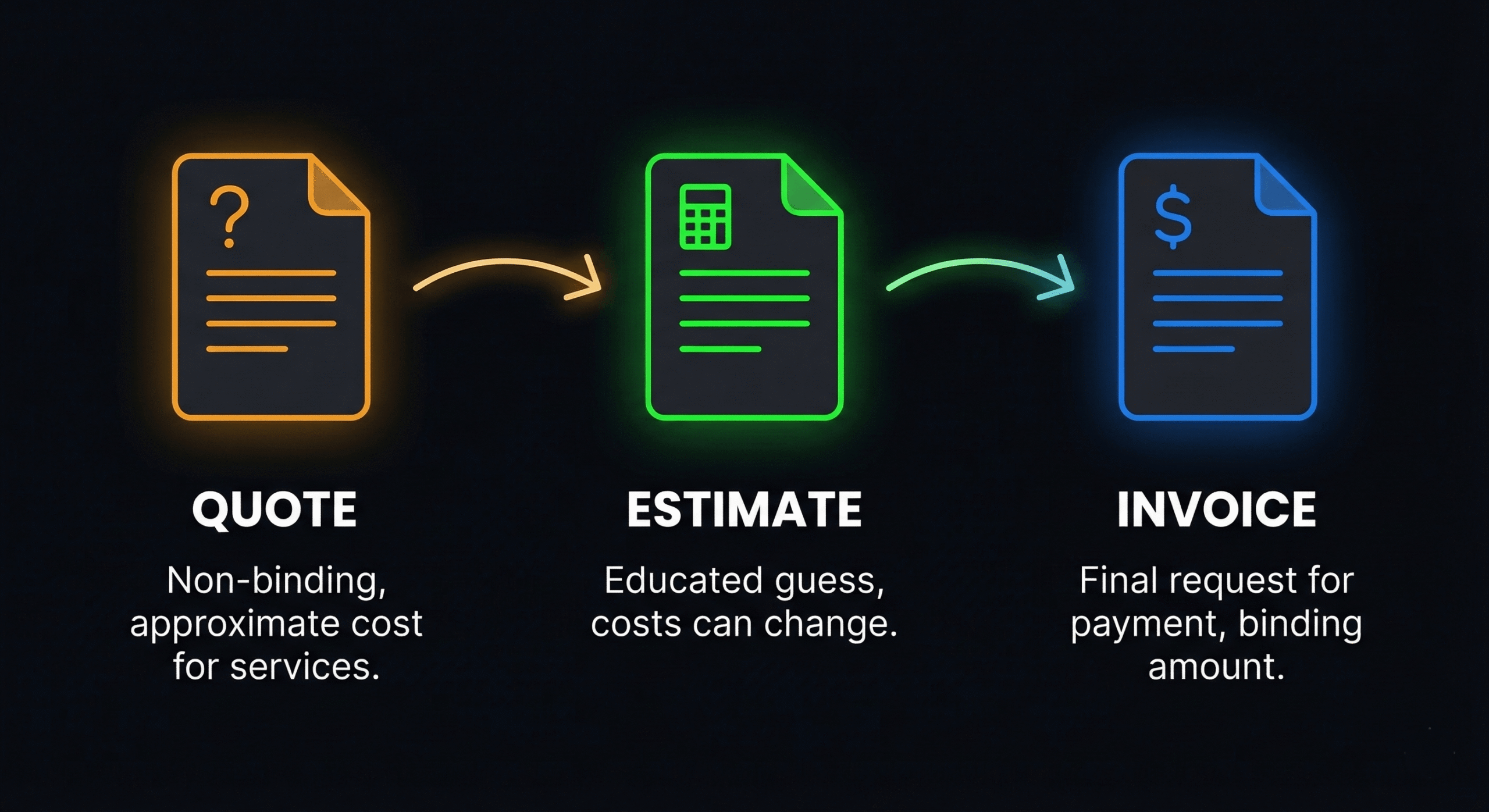
An estimate is an approximate calculation of the expected cost for a project or service. It’s not a commitment to a final price — it’s an educated guess based on the information available at the time. Estimates are typically used early in the sales process when the full scope isn’t yet defined.
- Binding? No. An estimate is non-binding. The final cost may be higher or lower depending on actual scope, time spent, and any changes.
- When to send: During initial client discussions, before scope is finalized, when the client asks “How much would this roughly cost?”
- What it includes: Approximate costs, a description of the anticipated work, any assumptions or exclusions, and a validity period (e.g., “This estimate is valid for 30 days”).
Example use case: A client asks you how much a website redesign might cost. You don’t have detailed requirements yet, so you provide an estimate of $8,000–$12,000 based on similar past projects, noting that the final price depends on the scope document.
What Is a Quote?
A quote (also called a quotation) is a fixed-price offer for a specific scope of work. Unlike an estimate, a quote commits you to that price as long as the scope doesn’t change. Once the client accepts the quote, it becomes the basis for the project agreement.
- Binding? Yes, once accepted. A quote is a commitment to deliver the specified work at the stated price. Changes to scope require a new quote or change order.
- When to send: After the discovery phase, when the scope is clearly defined and you can commit to a specific price.
- What it includes: Detailed scope of work, fixed total price, itemized line items, validity period (e.g., “This quote is valid for 14 days”), terms and conditions, and an acceptance mechanism (signature or written approval).
Example use case: After a discovery call and scope document, you quote $9,500 for a 5-page website including design, development, and testing. The client signs the quote, and that becomes your price commitment.
What Is an Invoice?
An invoice is a formal request for payment after work has been completed (or at a defined milestone). It’s the document that tells the client “You owe me this much, by this date, payable in this way.” For a complete walkthrough, see our guide on how to create an invoice.
- Binding? Yes. An invoice is a legally enforceable payment request backed by the contract or accepted quote.
- When to send: After work is delivered, at milestone checkpoints, or on a recurring schedule for retainer clients.
- What it includes: Your business details, client details, unique invoice number, itemized services/products, subtotal, taxes, total due, due date, and payment instructions.
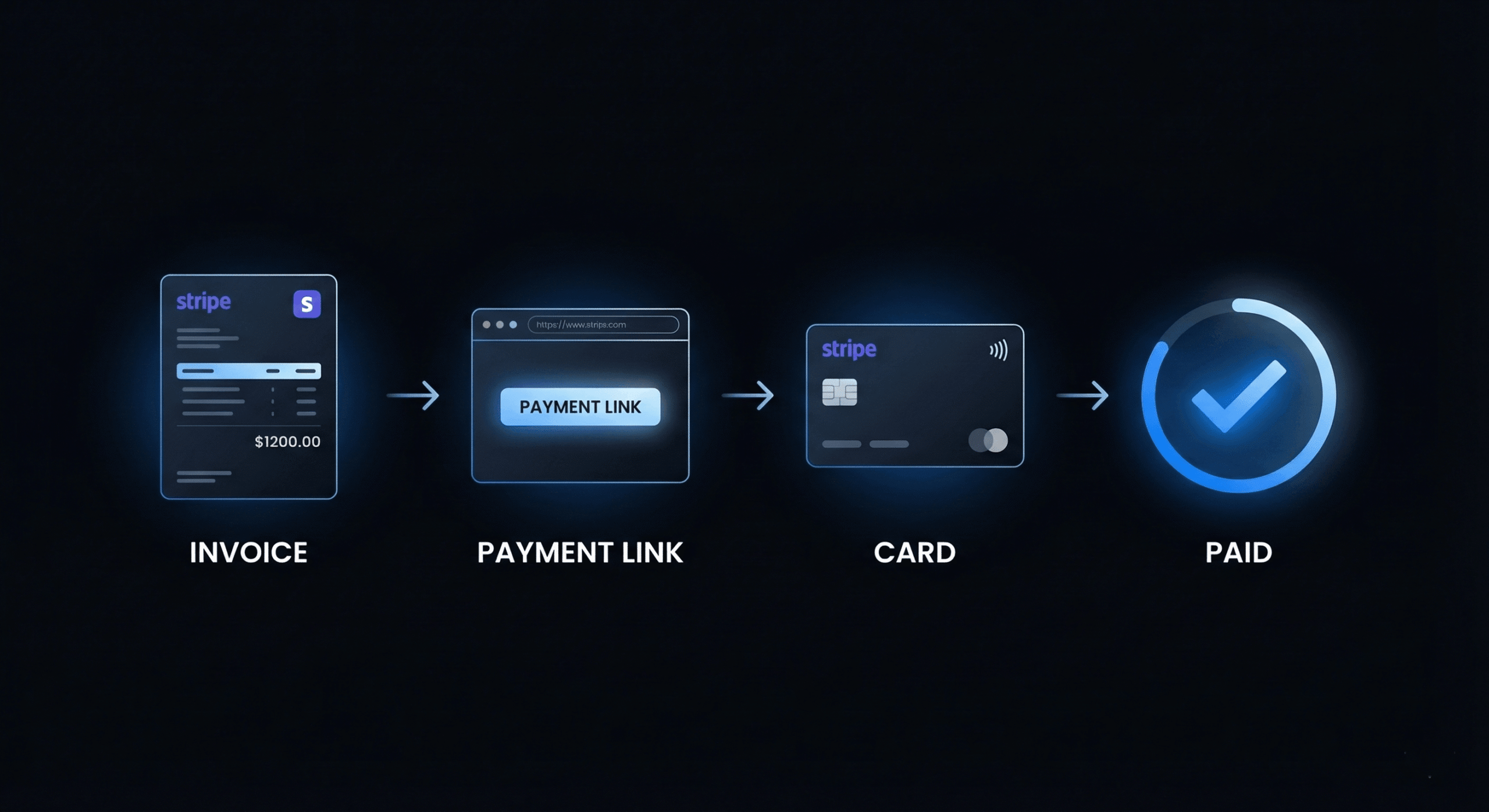
Example use case: You’ve completed the website and deployed it to production. You send an invoice for $9,500 (matching the accepted quote) with Net 15 payment terms and a Stripe payment link.
Side-by-Side Comparison: Invoice vs. Estimate vs. Quote
| Feature | Estimate | Quote | Invoice |
| Purpose | Approximate cost preview | Fixed-price commitment | Payment request |
| Binding? | No | Yes (when accepted) | Yes |
| Price | Range or approximate | Fixed and specific | Final amount due |
| When sent | Before scope is defined | After scope is defined | After work is delivered |
| Triggers payment? | No | No (triggers agreement) | Yes |
| Validity | Typically 30 days | Typically 14–30 days | Until due date |
| Legal weight | Low (informational) | Medium (contractual) | High (payment obligation) |
| Requires signature? | No | Yes (acceptance) | No (but tracks payment) |
The Complete Workflow: From Estimate to Invoice
Here’s how all three documents fit into a typical freelance project lifecycle:
Phase 1: Discovery → Estimate
The client reaches out with a project idea. You have an initial conversation to understand requirements at a high level. You send an estimate with an approximate cost range and the assumptions behind it. This helps the client decide whether to proceed and sets rough budget expectations.
Phase 2: Scope Definition → Quote
The client is interested. You conduct a deeper discovery session, define the scope in detail, and send a formal quote with a fixed price tied to specific deliverables. The client reviews, possibly negotiates, and accepts the quote (via signature or written approval). This becomes the financial foundation of your agreement.
Phase 3: Work + Milestones → Invoice(s)
You begin work. At agreed milestones (or upon completion), you send invoices referencing the accepted quote. Each invoice includes the specific deliverables covered, the amount due, and payment terms. The client pays via the invoice’s payment link.
Phase 4: Ongoing Work → Recurring Invoices
If the project leads to ongoing maintenance or retainer work, you transition to recurring invoices that bill automatically on a monthly schedule.
What About Proforma Invoices?
You may also encounter the term “proforma invoice.” A proforma invoice sits between a quote and an invoice. It looks like an invoice (with itemized charges and a total) but it’s issued before work is complete — often to request a deposit or to provide the client with a document they can use for internal budget approval.
- Key distinction: A proforma invoice is NOT a demand for payment. It’s a preliminary document that shows what the final invoice will look like. The actual payment request comes with the standard invoice after work is delivered.
- When to use: When a client’s accounting department needs an “invoice-like” document to approve a purchase order or release a deposit before work begins.
Common Mistakes When Using Estimates, Quotes, and Invoices
- Sending an estimate when you should send a quote. If the scope is clearly defined and the client is ready to commit, an estimate creates ambiguity. A quote locks in the price and moves the project forward.
- Treating a quote as an estimate. Once you send a quote, you’re committed to that price (within the stated scope). Don’t send a quote if you’re not confident in the price.
- Invoicing without an accepted quote. Sending an invoice for an amount the client hasn’t agreed to invites disputes. Always get quote acceptance before invoicing.
- Not including a validity period. Estimates and quotes should expire (14–30 days is standard). Without an expiration, a client could accept a year-old quote when your rates have increased.
- Using vague descriptions across all three. Whether it’s an estimate, quote, or invoice, specific line items are always better than generic descriptions. Clarity prevents disputes at every stage.
Best Practices for Freelancers
- Always start with an estimate for new, undefined projects. It sets expectations without committing you to a price you might regret.
- Convert estimates to quotes once scope is locked. The quote is your commitment. Make it detailed, specific, and conditional on the defined scope.
- Reference the quote number on every invoice. This creates a clear paper trail from proposal to payment.
- Use your invoicing tool for all three. DevInvoice lets you create estimates, quotes, and invoices in one platform, with automatic numbering and conversion from quote to invoice.
- Keep all documents. Maintain a record of every estimate, quote, and invoice for tax purposes and dispute resolution.
Frequently Asked Questions
Can an estimate become legally binding?
Generally no. Estimates are informational and non-binding by nature. However, if an estimate is extremely detailed and the client relies on it to their detriment, it could potentially be treated as a quasi-contract in some jurisdictions. To avoid confusion, always label estimates clearly and include a disclaimer that the final price may vary.
What if the project scope changes after I send a quote?
If the scope changes, issue a revised quote or a formal change order that documents the additional work and its cost. Never absorb scope changes silently — that’s how projects become unprofitable. See our guide on scope creep in freelancing for prevention strategies.
Do I always need to send an estimate before a quote?
No. If the project scope is clear from the start and you can confidently commit to a price, skip the estimate and go straight to a quote. Estimates are most useful when there’s significant uncertainty about scope or complexity.
Can I use the same tool for estimates, quotes, and invoices?
Yes. Modern invoicing tools like DevInvoice let you create all three document types in one platform, with consistent branding, automatic numbering, and the ability to convert an accepted quote directly into an invoice.
What’s the difference between a quote and a proposal?
A proposal is a broader sales document that typically includes your approach, methodology, timeline, team, and pricing. A quote is specifically the pricing component. Many freelancers combine both into a single “proposal” document, but the quote (pricing section) is the part that becomes contractually binding upon acceptance.
Use the Right Document at the Right Time
Estimates, quotes, and invoices each play a distinct role in your freelance business. Using them correctly sets clear expectations, builds client trust, and creates a smooth path from initial conversation to final payment.
➜ Create estimates, quotes, and invoices in one place — DevInvoice